
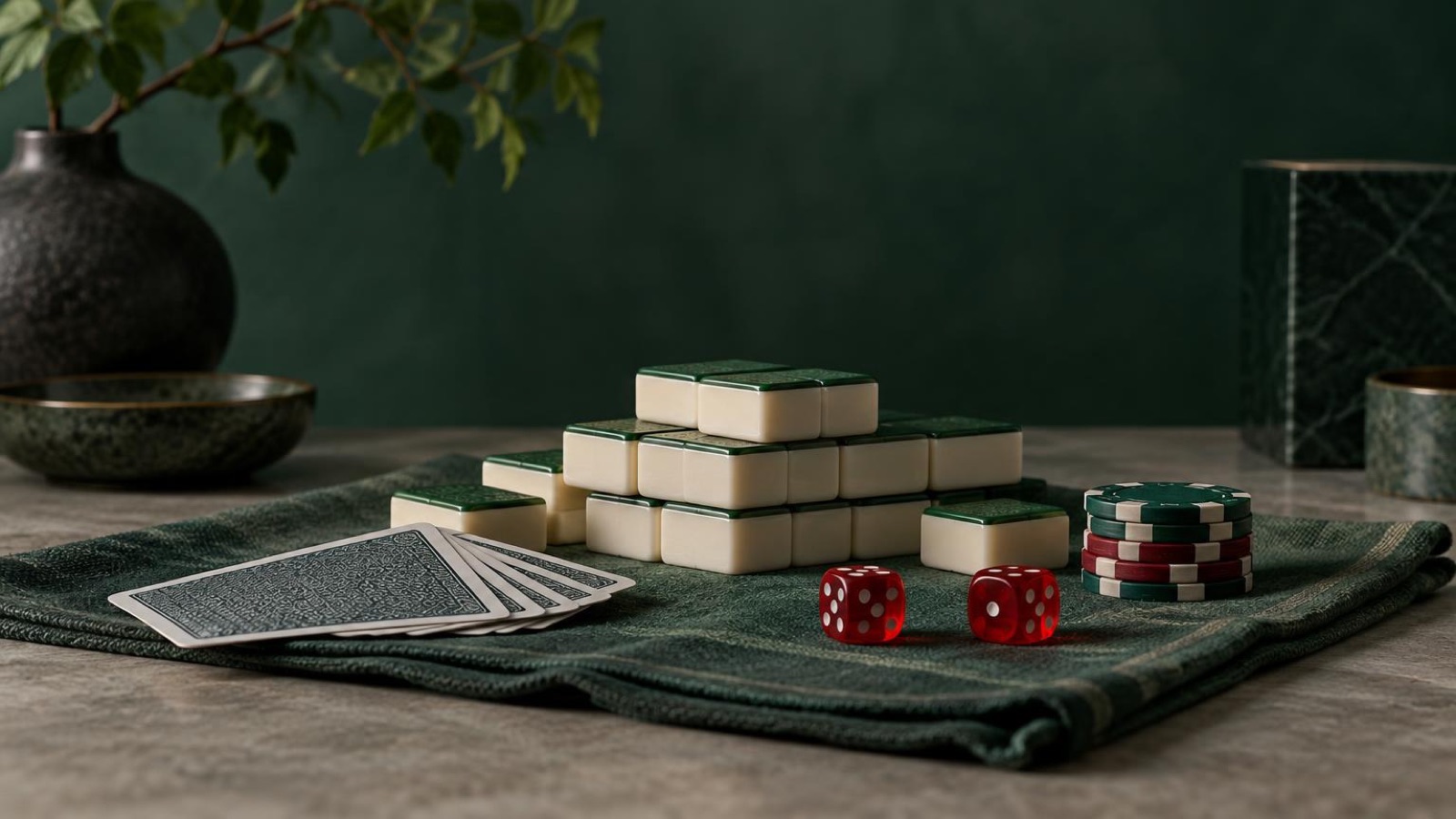
The games covered and where each one sits on the legal map
Asia's gambling games fall into a few broad families, and each family sits differently on the legal map.
Ball and machine games. Pachinko and pachislot are Japan's giant parlor industry, played in thousands of halls across the country. The machines themselves are legal to play, but the way money changes hands around them is deliberately indirect, which we explain below.
Tile games. Mahjong is played socially and competitively everywhere from China to Japan to Malaysia, and it has a huge legal online and club scene. Betting on it, however, is treated very differently from country to country, and in Japan it is flatly criminal. We cover that in its own section.
Card games. Teen patti and Indian rummy dominate in India, niu niiu and the climbing games like Big Two, Tien Len and Dou Dizhu run through China and Southeast Asia, and nine-point games like Pok Deng and Oicho-Kabu sit in between. Hanafuda and hwatu games such as Go-Stop and Koi-Koi are the traditional card games of Japan and Korea.
Dice games. Fan-tan, with its buttons counted into piles of four, is the classic Macau table game. Xoc Dia, Bau Cua, Cho-Han and Chinchirorin are the folk dice games of Vietnam, the Philippines and Japan.
Animal and racing sports. Sabong, cockfight betting, is licensed and regulated in the Philippines. Japan runs publicly managed betting on Boat Race and Keirin, and Korea runs its own equivalents under names like Kyungjeong for boat racing and Kyongryun for cycling.
Where each game is legal varies enormously. In South Korea, the officially sanctioned chance-and-skill games include horse racing, cycling racing, boat racing, poker and blackjack8, while internet gambling, hwatu, poker outside licensed settings and adult arcades are treated as illegal gambling9. In Japan, betting on mahjong is a crime regardless of the venue's name or place6. In Hong Kong, gambling across the board is restricted to those aged 18 and above7. For a full country-by-country comparison, see where Asian games are legal.
If you are visiting or living somewhere new and want to try the local games, our page on playing Asian games as a visitor or expat walks through what a first-timer can realistically join.
Pachinko: how the three-shop system works in Japan
Pachinko is the odd giant of world gambling: an industry the size of a small country's GDP that is not, on paper, gambling at all.
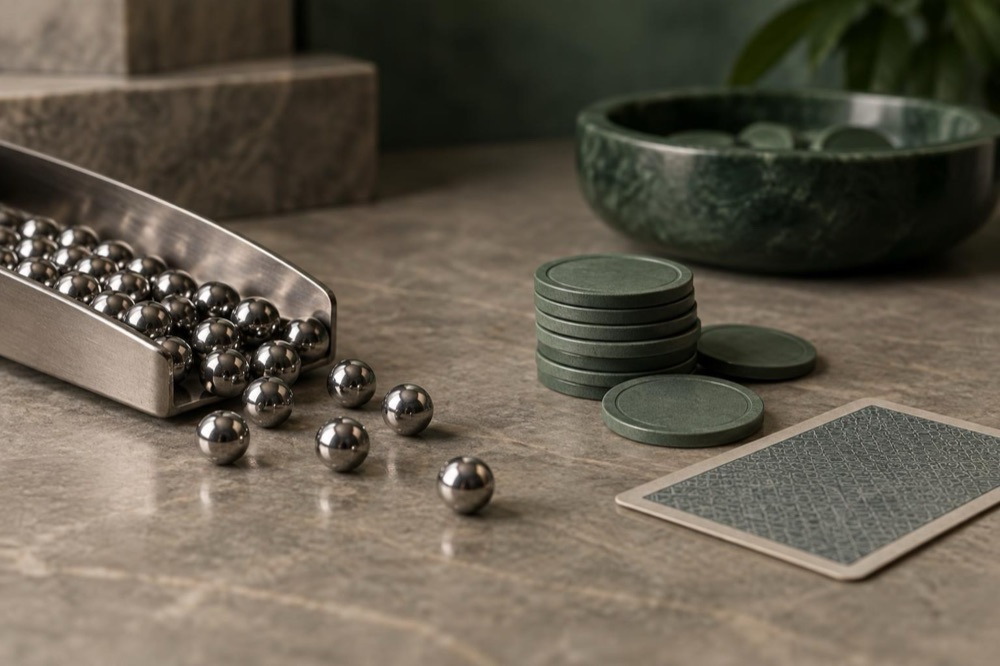
The game itself is simple. You rent a tray of small steel balls from the parlor, feed them into a vertical machine, and watch them cascade down through pins and obstacles. Most balls drain away. A few land in the winning hole, and when they do the machine pays out a flood of extra balls. Modern machines wrap this in elaborate animations, and "Smart Pachinko" machines add layers of modes and bonus rounds on top.
The legal gymnastics happen at the end. Japanese law forbids the parlor from paying you cash for your balls. So the parlor exchanges your winning balls for a prize, typically a small item like a token or a trinket. You then take that prize to a separate small shop, usually tucked around the corner from the parlor's exit, which buys the prize from you for cash. The parlor, the prize and the buyer are kept at arm's length from each other, and this three-step arrangement is what keeps the whole industry on the right side of the law. Everyone involved understands exactly what is happening, but the money never technically passes from the parlor to you for gambling.
Pachislot, the slot machine version, works the same way: you play with rented balls or credits, win more, exchange for a prize, and sell the prize nearby.
Japan's newer integrated resorts, licensed under its casino law, will offer conventional casino games, and the enforcement rules list the permitted game types, which include the money wheel among the approved table games10. That is a separate world from the pachinko parlor on the corner.
For how the machines actually work inside, including kakuhen modes and how to read a machine spec sheet, see pachinko machine specs. If you are curious about the discounted morning sessions many halls run, see morning service in pachinko.
What a pachinko jackpot actually costs you
Pachinko odds are published per machine, and they vary a lot. The specs for several Kaiji-themed machines show jackpot odds at the start of a cycle ranging from 1/99.8 up to 1/399.2, with one machine at 1/389.9 and another at 1/399.21. Once a machine enters its favorable mode, those odds improve dramatically, to roughly 1/29.9 to 1/39.91. In plain terms: a machine might let you hit a jackpot once every few hundred spins in normal play, but once you are in the good mode, roughly once every 30 to 40 spins.
The breakdown of what kind of jackpot you get also matters. On the machine CR Pachinko Hissatsu Shigotonin IV, the published jackpot breakdown for jackpots won through the denchu entry lists the following kakuhen types11:
| Jackpot type | Share of jackpots |
|---|---|
| SUPER Hissatsu jackpot (16R kakuhen) | 30% |
| Hissatsu jackpot (8R kakuhen) | 13.5% |
| Shutsujin RUSH (rank-up bonus, kakuhen) | 20% |
These shares cover the kakuhen jackpots listed for the denchu entry, and the machine's full jackpot breakdown includes further types beyond these. The "R" number refers to how many rounds of balls the jackpot feeds you, so a 16R jackpot pays out far more play than an 8R.
Costs at a pachinko hall are measured in balls, not yen per spin. You rent balls by the tray, and the exchange rate between balls and yen is posted in the hall. A long session on an unlucky machine can eat through several trays; a jackpot can pay out thousands of balls that you then carry to the counter in buckets. How much you spend is entirely a function of how long you play and how the machine treats you.
Where pachinko is banned or barely licensed: South Korea
South Korea is the clearest counterpoint to Japan. Adult arcades, the Korean equivalent of the pachinko-style gambling arcade, are listed by Korea's own racing authorities among the forms of illegal gambling, alongside internet gambling, hwatu and poker9. There is no Korean three-shop system, no gray-market parlor industry. Playing a gambling machine for money in Korea means playing outside the law.
What Korea does offer, officially, is a set of licensed chance-and-skill games: horse racing, cycling racing, boat racing, poker and blackjack8. These are run through the state's racing and sports betting bodies, and they are the legal route for a Korean resident who wants a flutter. Foreigners in Korea also have access to the foreigner-only casinos, which are a separate licensed category.
So the practical picture for a visitor: pachinko-style play is a Japan thing. In Korea, the equivalent impulse is served by the racing venues and the licensed casinos, and the arcade gambling that looks familiar from Japan is on the wrong side of the line. Our South Korea guide covers the licensed options in detail.
Boat Race: Japan's publicly managed betting on 24 racetracks
Boat Race, called kyotei in Japanese, is one of Japan's four public sports on which betting is legal and state-managed. Powerboats race three laps around a dedicated water course, and you bet on the finishing order.
There are 24 racetracks around the country, so wherever you are in Japan, one is likely within reach2. Getting to a venue is surprisingly simple, and the official guidance is aimed squarely at first-timers3. You can come to any Boat Race venue in Japan to watch the races, enjoy the food and check out the other attractions without placing a single bet12, which makes it a decent outing even for a non-gambler in your group.
Betting starts small. Every ticket type can be bought from 100 yen13, and you can simply pick your favorite color and place a bet with just 100 yen3. All payouts are made in yen2. The bet types are the familiar racing set: picking the winner, picking the top two in order or in any order, and picking the top three. Our Boat Race betting explained page breaks down each bet type and how the odds work.
The race day rhythm is worth knowing. Betting tickets can be purchased until the deadline for each race, and the actual race starts at least a few minutes later, which gives you time to grab a seat and watch12. You can also come to any Boat Race venue in Japan just to watch the races, enjoy the food, and check out the other attractions without placing a single bet12.
The venues also run special races and anniversary meetings. In September 2026 alone, the official site announced Ishikura Hiroyuki winning the Boat Race Ticket Shop Matsue 26th Anniversary Race, Suenaga Yuraku taking the Osaka Sports Cup at Boat Race Kojima, and Kasahara Ryo winning the Nikkan Sports Cup Nikkan Com Cup, also at Kojima. Racer Hiroshi Sudo reached his 2,000th career win at Boat Race Tamagawa during the G1 Wakey Cup 72nd Anniversary meet. Payouts on a big day can be substantial: the top daily trifecta payout recorded on September 24, 2026 was 256,790 yen at Kiryu.
Boat Race rules that decide your ticket: flying starts, late starts and refunds
Boat Race has a start rule unlike any other racing sport, and it can decide your ticket before the boats have gone 50 meters.
The start is a flying start: the boats approach a moving start line and must cross it exactly as the countdown clock hits zero. Cross the line even 0.01 seconds early and it is a flying start, called an F, and the boat is scratched from the race; the bets on that boat are refunded14. Cross the start line one second or more late and it is a late start, an L, and the boat may not race15. Either way, your carefully handicapped pick can be out of the race before it begins.
The refund rules are where it pays to know the details:
- If a boat is scratched, including for a flying start, all tickets on that boat are refunded14.
- All tickets for a withdrawn boat are refunded, so keep your ticket13.
- If a refund is made due to a false start or other problem, you simply insert your betting ticket into the betting machine to get your money back2.
- If your boat starts normally but then capsizes, sinks, or the rider falls overboard and fails to finish, the tickets on that boat are not refunded; the rider is disqualified under the race rules and may face suspension16.
That last point surprises people. A boat that never starts gets you your money back. A boat that starts and then flips does not.
Korea's equivalent, Kyungjeong, has its own refund schedule, and it is worth knowing if you bet there. When five or more boats start normally but no boat crossed the finish line, all bet types are refunded. When three or fewer riders start, the yeonseung, sambok, samsseangseung and ssangbokseung bets are refunded, and when two or fewer start, the yeon, bok, ssang, sambok, samsseangseung and ssangbokseung bets are refunded16.
Keirin: seven bet types and a 60-day window to collect
Keirin is Japan's public bicycle racing sport, and alongside it sits Japan's other public wheel sport, auto race. Betting on keirin is sold through official channels including telephone and internet voting accounts.

The core bet types are seven: the 2-frame quinella, 2-frame exacta, 2-rider quinella, 2-rider exacta, 3-rider trio, 3-rider trifecta, and wide, plus two multi-race ticket types called Dokanto!7 and Dokanto!4two17. In plain terms, you can bet on the top two riders in either order or in exact order, the top three in either order or exact order, or a wide bet that pays if your two chosen riders both finish in the top three. The Dokanto tickets string results across multiple races for bigger payouts. Night races and Midnight Keirin can also be purchased17. Our keirin betting explained page covers each type with examples, and if you are filling in a paper mark sheet at a venue, see how to fill in a KEIRIN mark sheet.
A "bet" has a specific meaning in the rules: a race number, betting method, combination number and number of tickets bundled together as one unit17. This matters because of the purchase limits. Through telephone voting, you can make up to 25 applications with up to 999 bets per application, or up to 50 applications with 999 bets each on PC internet voting, and up to 3,000 bets per day in total18. Through a net bank service, you are limited to 99 applications per day19. There is also a hard money ceiling: you cannot purchase more than 9,990,000 yen of tickets in a single day20.
The deadline that catches people out is collection. Tickets purchased through telephone and internet voting are received and kept on your behalf, and they can be viewed and collected only within 60 days of the day the race was held, at a place designated by the operator18. Miss that window and the ticket is worthless, whatever it was worth on the day.
Korea runs its own licensed cycling racing under Kyongryun, listed among the official chance-and-skill games alongside horse racing, boat racing, poker and blackjack8.
Mahjong in Japan: why betting on it is a crime at any stake
Mahjong itself is everywhere in Japan. Riichi mahjong is played in dedicated parlors, in homes, in online apps, and in professional leagues with televised title matches. What is a crime is betting on it.
The National Police Agency's guidance is blunt: mahjong gambling is a crime regardless of the place or the name of the venue, including mahjong parlors, so-called mahjong teaching facilities, homes and inns6. There is no small-stakes exception, no friendly-game carve-out. If money rides on the tiles, it is gambling under the criminal code, and if you are charged with the gambling offense, you face a fine of up to 500,000 yen or a petty fine6.
The practical consequence for a visitor: playing mahjong in a Japanese parlor is completely legal and quite fun, and the parlors charge table fees by the half hour rather than taking a cut of any pot. What you cannot do, at any stake, is put money on the outcome. Our mahjong parlors page covers how licensed halls work and what table fees look like, and riichi mahjong rules explains the Japanese variant if you want to sit down and play.
The contrast with the rest of Asia is stark. In most of the region, mahjong for modest stakes among friends is a normal part of festival life, especially around Lunar New Year, and licensed mahjong houses exist in several jurisdictions. Japan is the outlier in treating the bet itself, at any size, as criminal. Our festival gambling page covers where the Lunar New Year mahjong tradition sits legally.
Indian rummy: 13 cards, two sequences and the 80-point penalty
Indian rummy is the subcontinent's great cash card game, played between 2 and 6 players with two decks of cards and a total of two jokers21. Each player is dealt 13 cards, and a random card is selected as the wild joker for the game21.
The goal is to arrange your 13 cards into valid combinations and declare before anyone else. To make a valid declaration you need a minimum of two sequences, of which one must be a pure sequence, meaning a run of the same suit with no joker substituting in; the rest can be any valid combination of sequences or sets21. This pure-sequence requirement is the heart of Indian rummy strategy: until you have one, nothing else you build is safe.
Card values are simple. Ace, Jack, Queen and King are each worth 10 points, and every other card is worth its face value. Jokers and wild cards are worth zero21.
The scoring penalties are what give the game its bite:
- A wrong declaration costs 80 points21.
- A losing player's hand is counted as the value of all cards, capped at 80 points, if the player does not have two sequences including a pure sequence21.
- Dropping out early costs you: the first drop is 20 points, a middle drop is 40 points, and the last drop and maximum point loss is 80 points21.
- Three consecutive misses are treated as a middle drop, a 40-point loss21.
- If you leave the table after picking from the closed deck, it counts as a middle drop; if you have not picked any card, it is a first drop21.
In pool rummy the drop scores differ slightly: 20 points in a 101 pool and 25 points in a 201 pool, and dropping is not allowed in best-of-2 or best-of-3 formats21.
In points rummy cash games, the winner's cash is calculated as the sum of all opponents' points multiplied by the rupee value of the point, minus the platform fee21. So if you are playing at 1 rupee per point against three opponents who finish with 40, 30 and 20 points, the pool you win is 90 rupees before fees.
For the full rules with examples, see Indian rummy rules and rummy formats. Teen patti, India's other great gambling card game, works on poker-style hand rankings and is covered in teen patti rules.
Vietlott Keno: draws every few minutes and a VND 2 billion top prize
Keno in Vietnam is run by Vietlott, the state lottery company, and it is the fastest-moving legal gambling product in the country. A basic entry costs 10,000 dong4, and draws are issued every day from Monday to Sunday, starting in the early morning around 6:00 and running until around 21:55 in the evening, with a new draw every few minutes5. Ticket sales continue throughout the duration of each draw period22, so you can buy into a draw that is already underway.
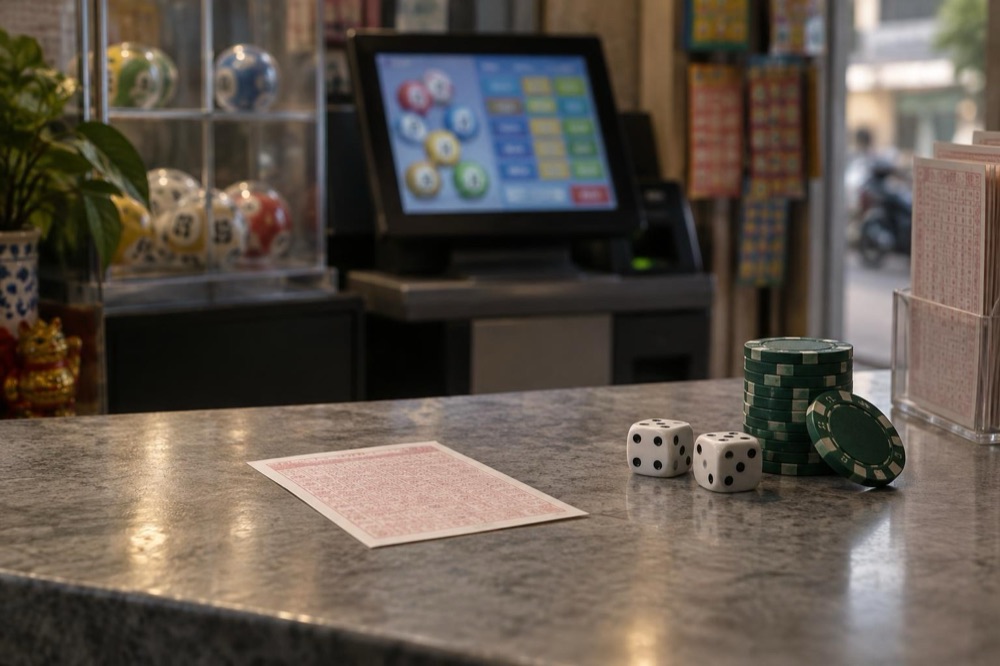
The game draws 20 numbers from a set of 01 to 80. You choose how many numbers to play, from 1 up to 10, and your payout depends on how many you match. The top prize for matching 10 out of 10 is 2 billion dong4. The prize structure is tied to the 10,000 dong entry value5, and in the case where there are five or fewer top-prize winners in a draw, each winner receives the full 2 billion VND23.
You can also play a string of draws in one purchase: a basic ticket can cover a maximum of 30 consecutive draws24, which is handy if you have a favorite set of numbers and do not want to rebuy every few minutes.
Two side bets run alongside the main game. In the Odd/Even game, an entry pays 200,000 dong if 15 or more of the 20 drawn numbers are even4. In the Big/Small game, an entry pays 10,000 dong if 11 or 12 of the drawn numbers fall in the 41 to 80 range, or likewise for the 01 to 40 range4.
For how the odds and payouts work across all spot counts, see how keno works.
Who is allowed to play: age and eligibility rules across the games
The eligibility rules differ by game and by country, and a few matter enough to state plainly.
Vietlott Keno in Vietnam is open to Vietnamese citizens, Vietnamese who reside abroad, and foreigners who have entered Vietnam legally22. That last group covers tourists and expats with valid entry, so a visitor can legally buy a Keno ticket at a Vietlott terminal.
In Hong Kong, gambling is restricted to those aged 18 and above7, a rule that applies across the licensed games.
In Japan, the mahjong rule is not about age but about the bet itself: betting on mahjong is a crime for anyone, in any venue, at any stake6. Playing without money is open to all.
In South Korea, the licensed chance-and-skill games, horse racing, cycling racing, boat racing, poker and blackjack, are the legal route for residents8, while internet gambling, hwatu, poker outside licensed settings and adult arcades are illegal9. Foreigner-only casinos are a separate licensed category open to visitors.
For the full picture across all twelve jurisdictions, including where mahjong, pachinko, sabong and teen patti are legal, see where Asian games are legal, and for the practical side of joining local games as an outsider, see playing Asian games as a visitor or expat.
All Pages in Section
- Legal Gambling on Asian Games by Country
- How to Play Mahjong
- How Many Tiles in a Mahjong Set
- Mahjong Variants
- Mahjong Scoring
- Riichi Mahjong Rules
- Mahjong Parlors in Hong Kong and Japan
- Online Mahjong for Money
- Mahjong Tournaments
- Pachinko Machine Specs
- Fan Tan Rules and Odds
- Niu Niu Rules
- Pok Deng, Bai Buu, Oicho-Kabu and Other Nine-Point Card Games Compared
- Big Two, Tien Len, Dou Dizhu and Guandan: Asia's Climbing Card Games Compared
- Asian Dice Gambling Games Compared: Xoc Dia, Bau Cua, Cho-Han, Chinchirorin and Bo Bing
- Hanafuda and Hwatu Games: Go-Stop, Matgo and Koi-Koi Compared
- Teen Patti Rules and Hand Rankings Explained
- Indian Rummy Rules: Sequences, Sets, Jokers and a Valid Declaration
- Points, Pool and Deals Rummy: How the Formats and Scoring Differ
- How Cockfight Betting Works: Meron, Wala, Kristos, Odds and Derbies
- How Keno Works: Spots, Odds and Payouts in Asia's Keno Games
- Jueteng, Satta Matka, Huay and Other Illegal Numbers Games in Asia
- Keirin Betting Explained: Bet Types, Odds and Mark Cards in Japan and Korea
- Boat Race Betting Explained: Kyotei and Kyungjeong Bet Types and Odds
- Mahjong, Teen Patti, Rummy and Niu Niu Online: Apps and Live Dealer Games
- Gambling During Lunar New Year, Tet, Diwali and Mid-Autumn: Traditions and the Law
- Playing Local Games as a Visitor or Expat: Mahjong Tables, Pachinko Halls and Cockpits
- Where Can I Watch Cockfights in Manila?
- What Is Morning Service in Pachinko and Pachislo?
- How Do You Play Cho-Han?
- How Do You Play Oicho-Kabu?
- What Are the Rules of Tien Len?
- How Are Hands Ranked in Pai Gow Tiles?
- How Does the Riichi Scoring System Work?
- How Do I Fill In a KEIRIN Mark Sheet?
- Chinchirorin vs Cee-Lo
- 25-Pai vs 30-Pai Medals
- Midnight Keirin vs Regular Keirin
- Go-Stop vs Matgo: Winning Scores
- Teen Patti vs Poker: Hands, Betting and Rules Compared
- E-Sabong: Online Cockfight Betting
- Mahjong Soul: How the Online Mahjong App Works and Whether It Is Gambling
- KEIRIN.JP and Chariloto: Online Keirin Betting Accounts
Common Questions
How many cards do you get in Indian rummy and how many players can join?
Each player is dealt 13 cards, and the game works for 2 to 6 players using two decks. A random card is selected as the wild joker for that game.
What is the minimum bet at a Boat Race venue?
Every ticket type at Boat Race in Japan starts at 100 yen. You pick your combination, and payouts are made in yen.
How much does a Vietlott Keno ticket cost and how often are draws held?
A basic entry costs VND 10,000. Draws run every day from early morning until late evening, with a new draw every few minutes and ticket sales continuing throughout each draw period.
What happens if a Boat Race boat starts too early or too late?
Crossing the start line even 0.01 seconds early is a flying start, and the boat is scratched with bets on it refunded. Crossing one second or more late is a late start, and the boat cannot race.
How long do I have to collect a winning Keirin ticket?
Tickets held on your behalf through telephone or internet voting are kept for viewing and collection only within 60 days of the day the race was held, at a designated place.
What are the jackpot odds on a Smart Pachinko machine?
Published machine specs show jackpot odds ranging from about 1/99.8 to 1/399.2 at the start, improving to roughly 1/29.9 to 1/39.9 once a machine enters its favorable mode.
Can foreigners play Vietlott Keno in Vietnam?
Yes. Vietlott Keno is open to Vietnamese citizens, Vietnamese residing abroad, and foreigners who have entered Vietnam legally.
Sources24 sources
- CR弾球黙示録カイジ, Wikipedia, 2026
- How to enjoy BOAT RACE, Boat Race official site, 2026
- Step-by-step guide, Boat Race official site, 2026
- Giới thiệu sản phẩm Keno, Vietlott, 2026
- Keno product introduction, English, Vietlott, 2026
- 遊技場営業等について, National Police Agency of Japan, 2026
- Bet limit, Hong Kong Jockey Club, 2026
- KBOAT FAQ, Korea Boat Racing Association, 2026
- KCYCLE FAQ, Korea Cycling Association, 2026
- カジノ施設整備推進委員会, Japan Casino Regulatory Commission, July 2021
- CRぱちんこ必殺仕置人IV, Wikipedia, 2026
- How to make predictions, Boat Race official site, 2026
- BOAT RACE guide level 1, Boat Race official site, 2026
- BOAT RACE extra, English, Boat Race official site, 2026
- Boat Race how to play, Chinese, Boat Race official site, 2026
- Motorboat racing ticket refund, Korea Boat Racing Association, 2026
- KEIRIN telephone voting agreement, SSNB, KEIRIN official site, May 2026
- KEIRIN telephone voting agreement, JPB, KEIRIN official site, May 2026
- KEIRIN telephone voting agreement, SMBC, KEIRIN official site, May 2026
- KEIRIN telephone voting agreement, Raku, KEIRIN official site, May 2026
- Rummy rules, RummyCircle, 2026
- How to play Keno, English, Vietlott, 2026
- Keno result detail, Vietlott, 2026
- Cách chơi Keno, Vietlott, 2026















