Win, place, quinella, trifecta: what each bet means
Almost every bet sold at an Asian racecourse is built from the same few ideas: pick one horse to win, pick one horse to finish near the front, or pick a group of horses to fill the top spots in a set order. What changes from country to country is the menu, the local names and the minimum stake.
Japan's JRA sells nine bet types: win, place, bracket number quinella, horse number quinella, quinella place (known as "wide"), exacta, trio, trifecta and the five-race WIN5 jackpot1. Local government racing in Japan offers a similar nine standard types, with a bracket-number exacta in place of WIN52. Hong Kong's menu covers win, place, quinella, quinella place, forecast, tierce, trio, First 4 and a long list of multi-race bets3. Korea's law allows eight betting methods, from win through trifecta and special betting9. The Philippines goes furthest on exotics, with pentafecta (first five in order) and Pick-6 among its principal bet types10.
The core four, though, are the same everywhere:
- Win: your horse finishes first.
- Place: your horse finishes in the top three, or top two in small fields.
- Quinella: your two horses finish first and second, in either order.
- Trifecta: your three horses finish first, second and third, in that exact order.
If you are new, start with the win and place bets, then work up through the two-horse bets and three-horse bets as the rest of this page explains them.
Win bet: your horse must finish first
The win bet is the simplest thing on the menu: pick one horse, and it has to cross the line first. In Japan it is called tansho, and the JRA's beginner materials describe it plainly as a bet on the horse that finishes first11. Hong Kong's rules define it as selecting the first-placed horse in a race with four or more declared starters3. In Korea the same bet is labeled W, "pick one horse to finish 1st"12.
The payout depends on how much money lands on your horse relative to the rest of the pool. In the JRA's worked example, horse No. 2 is quoted at odds of 1.9, so a JPY 100 win bet pays JPY 1908. The odds shown on the tote board are not fixed at the moment you glance at them: they keep updating as money comes in, right up until the race starts13.
Your chance of winning with a single pick is simply one divided by the field size. With 12 horses running, a win bet on one horse is a 1 in 12 shot5.
Place bet: top three, or top two in small fields
A place bet pays if your horse finishes in the top three. In Japan this is fukusho, and the rule is that the horse must finish within third place, or within second place when seven or fewer horses run14. The bet is only available when five or more horses line up15. Hong Kong's rules are similar: a horse in a race with seven or more declared starters must finish first, second or third, and in a race with four to six starters it must finish first or second16.
The JRA's worked example shows what a place bet feels like in practice: if horse No. 2 finishes in the first three, a bet of JPY 100 pays out between JPY 110 and JPY 1308. Place bets pay less than win bets on the same horse because more combinations in the pool are winners.
How the dividend is calculated matters here. In Hong Kong's commingled place pool, the net pool after takeout is shared among the bets on the placed horses that were backed. If none of the placed horses attracted a single bet, the whole pool is refunded4. That means a place dividend on a lightly backed outsider can be surprisingly large, while a place bet on a heavy favorite can return barely more than your stake.
In North American terminology, which you may see at simulcast windows or in translated guides, this bet is called "show," and one Chinese-language guide calls it the safest bet for beginners because your horse only needs to reach the top three17. For more detail, see win and place bets.
Quinella: first two in any order
The quinella asks you to pick the first two finishers, and the order does not matter. Japan's official guide describes it as picking the horse numbers of the first and second horses in any order15; Hong Kong's rules say the same, that the backer selects the first and second horses regardless of finishing order3. In Korea it is the Q bet, "pick two horses to finish 1st and 2nd in either order"12.
With 12 horses running, a single quinella combination has a 1 in 15 chance, because there are 66 possible pairs and each pair can come home two ways18. That is much better than the exacta's odds on the same two horses, and the trade-off is a smaller dividend.
Japan adds two twists on the idea. The bracket quinella (wakuren) asks you to pick the bracket numbers, not horse numbers, of the top two finishers in any order; it is not sold when eight or fewer horses run14. The quinella place, better known as "wide," asks you to pick any two of the top three finishers in any order, and is sold only when nine or more horses run15. Hong Kong's quinella place is the same bet: any two of the first three placed horses, regardless of order3.
For the full picture, see quinella and quinella place.
Exacta and forecast: first two in the right order
The exacta is the quinella's stricter cousin. You pick the first and second finishers, and they must arrive in the order you named. Japan calls it umatan, and Kanazawa's guide describes it as picking the pair of first and second place horse numbers in the exact finishing order19. Hong Kong calls the same bet the forecast, defined as selecting two horses to finish first and second in the correct order3, and Singapore's racing school teaches it the same way20.
Because each pair can finish two ways, a single exacta combination is twice as hard to hit as the quinella on the same horses, and the dividend reflects that. This is also why an exacta box costs double a quinella on the same two horses: you are buying both orders.
The distinction between the two bets confuses everyone at first, so we give it a page of its own: exacta vs quinella.
Trifecta: the first three in exact order
The trifecta asks for the first three finishers in the exact order: first, second, third, named correctly. Japan's guide calls it picking the horse numbers of the first, second and third horses in finishing order15. Hong Kong's rules define it the same way3, and the Philippines lists it among its principal bet types10.
The numbers explain why the dividends can be spectacular. With 12 horses running, a single trifecta combination has a 1 in 1,320 chance5. In Japan the bet is only sold when nine or more horses run15, which keeps the minimum number of combinations manageable. In the JRA's worked example, a JPY 100 trifecta on the combination 2, then 14, then 12 pays JPY 5,1908.
Japan also sells the trio (sanrenfuku), which is the forgiving version: pick the first three finishers in any order15. Hong Kong's equivalent is the tierce's sibling, the trio, and Hong Kong also runs a tierce, which is the first three in correct order3. The relationship between trifecta, tierce and trio is set out in detail on the three-horse bets page.
Multi-race and forecast bets: First 4, exacta and wide
Beyond single-race bets, every operator sells bets that stretch across the finishing order or across several races.

Four-horse bets. Hong Kong's First 4 asks for the first, second, third and fourth horses in a nominated race, and the Chinese-language rules describe the same bet, four horses in finishing order in one designated race4. The Philippines sells a quartet, defined as the first four place finishers in exact order of arrival7, and goes one further with the pentafecta, the first five in exact order7. Singapore's rules set a S$2 minimum on forecast, place forecast, tierce, trio and quartet bets6. See First Four and Quartet.
Multi-race bets. Hong Kong's All Up system lets you combine bets across two to six races, in the same or different pools, with any dividend from a winning leg automatically carried forward and reinvested in the next leg21. The pools you can chain depend on the number of races: forecast and trio for two or three races, and win, place, quinella, quinella place, forecast or trio for up to six21. Hong Kong's classic multi-race products include the Double Trio, the first three in each of two designated races in any order4, the Triple Trio, the first three in each of three races in any order4, and the Triple, the first-placed horse in each of three designated races4. Racecards list the legs, for example a first treble spanning races 2, 3 and 4. Japan's answer is WIN5, the five-race jackpot where you must find the winner of all five legs1. The multi-race bets page covers these, and the jackpots and carryovers page explains what happens when nobody wins.
Wide. Covered above as Japan's quinella place, but worth naming here because it sits between the place and the quinella on every Japanese menu: two horses, both in the top three, any order15.
How the tote works: pools, dividends and fixed odds
Nearly every bet described on this page is pari-mutuel, meaning the money all goes into a shared pool. The operator deducts its takeout, and the rest is divided among the winning tickets. The Hong Kong Jockey Club's betting guide walks through its pari-mutuel pools, its fixed odds bet types, and the formulas used to settle them22.
Two consequences follow. First, the odds on the board are a live estimate, not a promise: they move with the money until the race starts13. Second, you are not betting against the house but against the other bettors, so a dividend depends on how popular your combination is.
Not everything is pooled. Some products, like Hong Kong's Jockey Challenge, pay at fixed odds set at the moment the bet is accepted, immune to later odds changes21. The commingled pools page explains how Asian pools are linked with overseas operators on big international race days.
Minimum stakes and payouts across Asian tracks
Minimum stakes vary widely, so check before you queue.
| Where | Bet | Minimum stake |
|---|---|---|
| Japan (JRA and most local tracks) | All bet types | JPY 100 per unit23 |
| Japan (JRA, by law) | Pari-mutuel tickets | Face value down to JPY 1024 |
| Singapore (account betting) | Win and Place | S$56 |
| Singapore (account betting) | Forecast, Place Forecast, Tierce, Trio, Quartet | S$26 |
| Philippines | Win and Place | PHP 57 |
| Hyderabad, India (Malakpet bookmakers) | Win or place | Rs. 10025 |
In Japan, the JPY 100 unit is the practical standard at local tracks like Sonoda and Himeji23, and the law allows the JRA to sell tickets with a face value as low as JPY 1024. Combination bets multiply fast: a box or "formation" ticket covering several horses costs the unit price times the number of combinations, and Japanese tracks publish combination tables so you can see the cost before you commit26. The banker, box and flexi bets page shows how to build these, and the minimum and maximum bets page has the full picture.
How many bet types each country allows
The menu is set by law in most jurisdictions, and the counts differ:
- Japan (JRA): nine types, the eight core bets plus WIN51. The JRA's own beginner materials count eight standard betting tickets27, with WIN5 as the multi-race addition.
- Japan (local racing): nine standard types at courses like Kanazawa28 and eight at others, such as Sonoda and Himeji, which sell win, place, bracket quinella, quinella, wide, exacta, trio and trifecta23. Off-track outlets mirror the host track's menu; Offt Tatebayashi lists nine29, and DASH Kure lists eight30.
- Korea: eight betting methods by law, from win through quinella, exacta, place, quinella place, tierce, trifecta and special betting9. In practice the principal bet types listed for Korean racing are win, place, quinella and exacta31.
- Hong Kong: a long menu defined in the betting rules, including win, place, quinella, quinella place, forecast, place forecast, tierce, trio, quartet, First 4, double, double trio, triple trio, six up, all up and roll betting3.
- Singapore: win, place, forecast, place forecast, tierce, trio and quartet, with All Up combinations across them6.
- Philippines: the widest exotic range, with daily double, forecast, winner-take-all, Pick-6, quartet, trifecta, superfecta, pentafecta, win, place and triple-trifecta listed as principal bet types10.
Japan's Horse Racing Act itself names only five methods of pari-mutuel betting, win, place, correct-order forecast, either-order forecast and multiple betting, with the detailed bet types created under those headings24. If you are betting online rather than at a window, the app menus match: JRA's smartphone site lists the same eight core bets32, and the SMAPPY card app adds a combined win-and-place option33.
How to place your bet at the window
At a tote window, the teller needs four things, in this order: the race number, the type of bet, the amount of your bet, and your horse's number7. At windows taking bets on several meetings at once, add the track name to the front of the sequence17.
So a win bet at a Japanese local track sounds like: "Race 5, win, 100 yen, horse No. 4." In Hong Kong or Singapore you would name the pool the same way: race number, then "win" or "quinella" or "trifecta," then your stake, then your numbers.
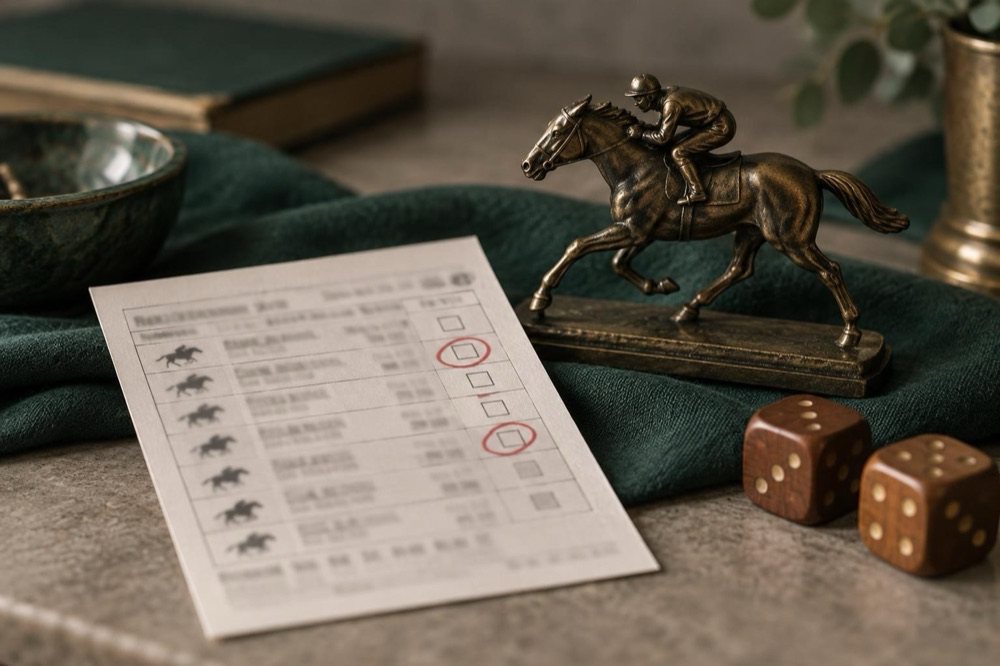
If you are marking a paper betting card instead, the layout follows the same logic. A Japanese local-racing card has separate areas for each bet type, with the quinella asking you to mark two horses and the trifecta three, in first, second and third positions34. Kanazawa's guide walks through the same marking process for its nine bet types28, and Kasamatsu's beginner page explains how to buy tickets for all eight types sold there35.
A few practical points for a first visit:
- Decide your bet type and stake before you reach the window; queues move fast between races.
- Horse numbers, not names, are what you give the teller7.
- Keep your ticket. It is your only claim on a dividend, and the claiming dividends page explains deadlines and lost tickets.
- If your horse is scratched, the scratched horse refunds page explains what happens to your money.
For the wider picture of where you can bet, which tracks run which meetings, and how seasons work across the region, start with the horse racing in Asia overview.
Common Questions
What is the difference between a quinella and an exacta?
Both cover the first two finishers. A quinella pays if your two horses finish first and second in either order, while an exacta requires you to name the exact one-two sequence. The exacta is harder, so it pays more when you get it right.
What is the minimum bet on a win or place bet?
It depends where you bet. In Japan most tracks sell tickets in units of JPY 100. In Singapore, Win and Place bets start at S$5 through an account. In the Philippines the minimum is PHP 5, and at Hyderabad's Malakpet course bookmakers accept nothing under Rs. 100.
How is a place bet payout calculated?
The money bet on all placed horses goes into one pool. After the operator's takeout, the net pool is divided among the winners on each placed horse, so a heavily backed horse pays less. If no one backed a placed horse, all bets in the pool are refunded.
What information do I need to give at a tote window?
Give the race number, the type of bet, the amount, and your horse's number, in that order. At some windows you may also need the track name if several meetings are being bet at once.
How much does a quinella box cost compared with an exacta box?
A quinella box with two horses is one combination, while the same two horses as an exacta box is two combinations, one for each finishing order. So the exacta box costs twice as much for the same pair of horses.
What are the odds of hitting a trifecta?
In a 12-horse field, a single trifecta combination has about a 1 in 1,320 chance. In Japan the bet is only sold when nine or more horses run, which is why the minimum field size matters.
Is there a minimum age for betting at the tote?
Yes. In Japan you must be 20 or older to buy betting tickets, and the same age limit applies at racecourse betting windows and off-track outlets. Other Asian jurisdictions set their own minimum ages, typically 18 or 20.
Sources35 sources
- JRA Racing Guidebook 2026, Japan Racing Association and Asian Racing Federation, 2026
- Racing glossary: bet types, Japan Racing Association, accessed October 2026
- Horse Race Betting Rules, Chapter 1, Hong Kong Jockey Club, May 2025
- Horse Race Betting Rules, Chapter 1 (Chinese), Hong Kong Jockey Club, May 2025
- How to bet, Sonoda-Himeji Racecourse, accessed October 2026
- Bet placement guide: horse racing, Singapore Pools, January 2026
- Getting started with betting, Philracom, accessed October 2026
- How to Go Racing (English guidebook), Japan Racing Association, 2026
- Korea Racing Authority Act, Article 7, Korea Law Translation Center, accessed October 2026
- Philippines racing profile, Asian Racing Federation, archived March 2016
- Beginners Book 2026, Japan Racing Association, 2026
- Horse racing information: bet types, Korea Racing Authority, accessed October 2026
- Understanding odds, Ontario Racing, accessed October 2026
- Betting types (Chinese), Sonoda-Himeji Racecourse, accessed October 2026
- How to bet on local government racing, Japan Racing Association, accessed October 2026
- Horse Race Betting Game Rules, Singapore Pools, July 2026
- How to place a bet, Ontario Racing, accessed October 2026
- Boat Race betting types, Boat Race Promotion Association, accessed October 2026
- Beginner's guide to betting, Kanazawa Racecourse, 2026
- How to bet forecast, Singapore Pools Racing School, accessed October 2026
- Racing Guide: All Up and Cross Pool All Up, Hong Kong Jockey Club, 2024
- Beginners' guide to betting, Hong Kong Jockey Club, accessed October 2026
- Hi-Bet guide, Sonoda-Himeji Racecourse, accessed October 2026
- Horse Racing Act, Japan Racing Association, 2023
- HRC Bookmakers Betting Rules, Hyderabad Race Club, accessed October 2026
- How to bet (English), Japan Racing Association, accessed October 2026
- Beginners Book, Japan Racing Association, April 2025
- Betting tickets, Kanazawa Racecourse, 2026
- Offt Tatebayashi, Tokyo City Keiba, accessed October 2026
- DASH Kure, Sonoda-Himeji Racecourse, accessed October 2026
- Korea racing profile, Asian Racing Federation, archived January 2011
- A-PAT betting instructions, Japan Racing Association, October 2025
- How to use SMAPPY, Japan Racing Association, accessed October 2026
- Betting card guide, Sonoda-Himeji Racecourse, accessed October 2026
- Buying betting tickets, Kasamatsu Racecourse, accessed October 2026