
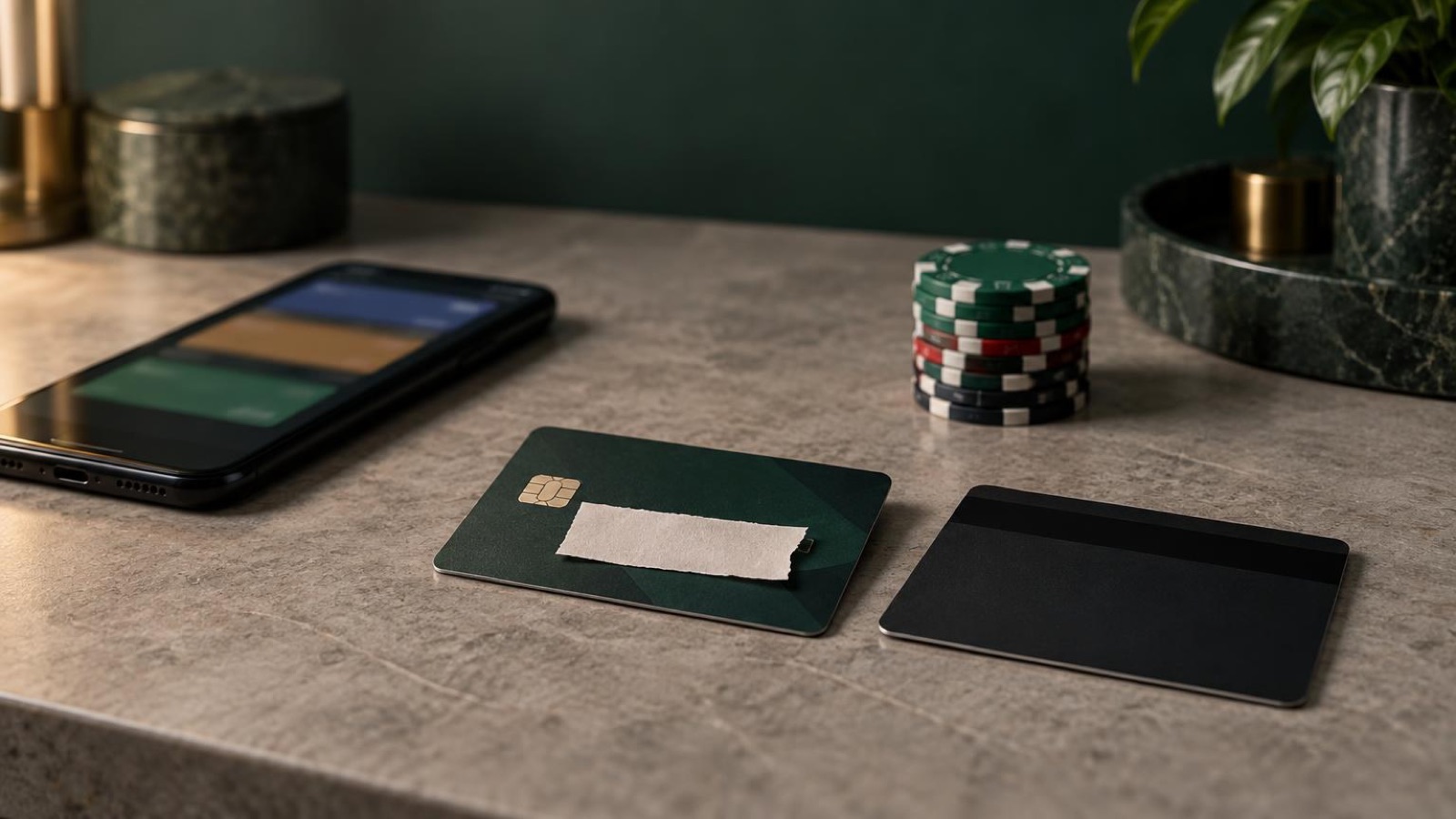
What payment method verification is
There are two checks a casino can run on you, and people mix them up constantly.
The first is identity verification. That is you proving you are the person named on the account: a passport, a driver's license or a national ID card, plus something showing where you live.
The second is payment method verification. That is you proving that the card, bank account or e-wallet you used to put money in belongs to you, and not to your partner, your friend or someone you bought an account from. It is a narrower question, and it is the one that most often holds up a cashout.
Operators describe the purpose plainly: the documents are used to validate either a member's identity or their ownership of any credit or debit cards they may have used, to make sure withdrawals are paid to the correct recipient, and in some cases to offer higher deposit limits1. Notice the second half of that. Verification is not only a gate. Passing it can raise your deposit ceiling.
The practical consequence is that a casino can accept your money in seconds and still not be ready to send money back until the ownership question is settled. That is not a trick, though it feels like one the first time. It is how the payout side of the business is built.
Why casinos ask for card photos and wallet screenshots
The short version: because a deposit can be made by anyone with the card details, but a withdrawal has to land in an account that belongs to the account holder.

If a casino paid out to whatever card or wallet was typed in at the cashier, it would be a laundering channel. Someone could deposit with a stolen card, lose or win, and cash out to a different account entirely. Requiring proof of ownership closes that loop. It also protects the operator in a chargeback dispute, because it can show the deposit came from a card the account holder controlled.
There is a second, more mundane reason. Operators are required to know their customers before releasing money. Licensed operators require proof of identity and other documents to be verified before they can release a payout, and that set includes proof of ownership of the deposit method4. A regulator in the Philippines goes further and requires a full KYC and identification verification process before the first withdrawal or cash-out request, or within seven days of registration, whichever comes first5.
For you, the useful takeaway is timing. Verification is triggered by a withdrawal request, by a cumulative transaction threshold, or by a risk flag on a deposit. It is rarely triggered by signing up.
Documents casinos commonly request
The list is fairly standard across licensed operators. Expect some or all of the following.
- Photo identification. A passport, driver's license or national ID card, with the photograph page showing your name, photograph and signature clearly1.
- Front and back of each card used to deposit. With the middle eight numbers on the front and the three digit security code on the back blocked out1.
- Proof of address. A recent utility bill or credit card statement showing your full name and the address registered on your account. If you use a credit card statement, blank out the middle eight numbers1.
- A live selfie. Some operators ask for a selfie holding your ID, alongside the photo ID and a proof of address dated within the last three months6.
- Bank or wallet evidence. A statement or transaction log showing the deposit leaving your account, where the card image alone does not settle the question.
Some operators also reserve the right to ask for notarized documentation in exceptional cases1. That is rare, and usually only where there is a genuine mismatch or a dispute.
One operator runs the whole thing through a secure portal on its own site rather than by email, and states that documents are not stored on its servers3. That is the model to prefer. If a site asks you to email a full card image to a generic support address, slow down.
How to take a card photo that passes verification
Most rejections are photographic, not substantive. The card is genuinely yours, but the image does not let anyone confirm it.
A card photo that passes usually has these qualities:
- All four corners visible. No cropping the edges off. The reviewer needs to see the whole card.
- The cardholder name readable. This is the single most important element, because it is what gets matched against your account name.
- The first six and last four digits readable. These are what get matched against the deposit record.
- The middle eight digits blocked. Cover them physically with a slip of paper, or black them out digitally. Do not blur the whole number.
- The three digit security code on the back blocked. Same treatment.
- Flat, well lit, no glare. Lay the card on a plain surface. Avoid flash reflections across the numbers.
- Both sides in one submission. Front and back together, so the reviewer does not have to come back to you.
Do not edit the image beyond blocking. Heavily filtered or resized images get rejected because the reviewer cannot tell what has been altered.
The same logic applies to a wallet screenshot. If you deposited through an e-wallet, the screenshot needs to show your name or account identifier, the transaction, the amount and the date. A cropped screenshot showing only the amount proves nothing about ownership.
Deposit proof: receipts, bank statements and transaction logs
Sometimes the card image is not enough, and the operator wants to see the money actually move.
This comes up most often when the deposit was made through an instant bank transfer or a QR payment, where there is no card to photograph. In Singapore, for example, PayNow deposits can fail an account status check, exceed a deposit limit, be flagged as a duplicate transaction if the same QR code is used more than once, or be rejected outright because the account is a third party, joint or corporate account8. Any of those flags can trigger a request for proof.
What counts as good deposit proof:
- A bank statement line showing the debit, with the date, amount and the merchant descriptor visible.
- A transaction log or receipt from the payment app, showing the same details plus your account name.
- A wallet history screenshot showing the outgoing transfer to the operator.
What usually does not count: a screenshot of your casino balance, a screenshot of the deposit confirmation page inside the casino, or a photo of a paper receipt with no account name on it. Those show that a deposit happened, not that it came from you.
If the deposit went through a bank transfer, be aware that the destination account may not have been visible to you at the time. A survey of online casino sites found that none of the sites using bank transfer disclosed the deposit destination or withdrawal source account before member registration, so the accounts could not be identified in advance7. That is worth knowing if you are later asked to produce evidence of where your money went.
Common reasons verification fails
The failures cluster into a handful of causes.

The name does not match. The card says one name, the casino account says another. This is the most common failure and the hardest to fix after the fact.
The payment method belongs to a third party. Deposits made using a payment method belonging or registered to a third party are invalid, and winnings from them are null and void and subject to forfeit2. This is not a technicality. It is the rule the whole verification process exists to enforce.
The image is unusable. Cropped, blurred, glared, or with the name obscured along with the number.
The proof of address is stale or mismatched. It needs to be recent and show the address registered on the account1.
The deposit itself was flagged. Duplicate QR use, a limit breach, or an account status failure can all stall things even when your documents are perfect8.
The payment method is no longer valid. If a card has expired or a wallet has been closed, the operator cannot pay back to it, and the default assumption breaks.
How long verification takes and what happens after
Review times vary, but the published figures give you a realistic range.
One operator states its verification team aims to review submitted documents within 2 to 3 business days3. At the payout end, published processing times for a group of casinos run roughly as follows9:
| Stage | Typical time |
|---|---|
| KYC review | Within 2 business days, up to 3 business days at some operators |
| Pending period after approval | 24 hours to 3 business days |
| Bitcoin payout | 24 to 48 hours, or within 24 hours |
| Bank transfer or check | 3 to 5 business days, up to 15 business days at some operators |
One operator lists 5 working days to process payouts, and another lists e-wallet and Bitcoin payouts as instant once processing is done9. A separate set of published times puts KYC at up to 3 business days, a pending period of 3 to 7 business days, and processing of a further 3 to 7 business days10.
The pattern to take from this: verification is usually the shortest part of the wait. The pending period and the payment rail are often longer. If your withdrawal has been sitting for a week, the bottleneck is more likely to be the pending window or the bank than the document review.
Once you pass, the account status is upgraded, which the operator says ensures prompt payments and in some instances increased deposit limits11. That is the upside. Verified accounts move faster on every subsequent withdrawal.
What casinos cannot ask you to send
There is a limit to what a verification request should contain, and it is worth knowing where the line sits.
A legitimate request never needs your full card number and security code together. The standard instruction is to block the middle eight digits and the three digit code1. If someone asks for the unblocked version, that is not a verification request.
A legitimate request also does not need your online banking password, your one time passcode, or remote access to your device. No operator needs to log into your bank.
And a legitimate request does not need a payment method that is not yours. You cannot verify a card or wallet registered to someone else, because the rule is that third party payment methods are not permitted for deposits at all2.
Some markets restrict which payment methods can be used in the first place, which affects what there is to verify. In Macau, staff monitoring casino entry may only require proof of age and may bar entry to those who refuse to show it, and may not require identity documents12. In Hong Kong, credit card bets are not accepted under basketball betting license conditions13. In South Korea, credit card payment is not allowed for Kangwon Land casino entry tickets14.
Verification at crypto and e-wallet casinos
Crypto and e-wallet deposits feel anonymous, and that feeling is misleading.

Crypto deposits can be near-instant, and most sites accept credit cards, e-money such as Vega Wallet, Payz and Jeton Wallet, crypto assets such as Bitcoin and Ethereum, and bank transfer, with deposits reflected immediately7. None of that removes the ownership question at withdrawal.
One operator makes verification mandatory at certain thresholds, typically EUR 1,000 to 2,000 of cumulative transaction volume6. Below that, you may deposit and play without documents. Above it, or at the point you request a cashout, the checks arrive.
For crypto specifically, the practical issue is that a withdrawal method has to be enabled on your account. If Bitcoin is not listed among the withdrawal methods but is accepted for deposits, you are told to contact support15. That is the crypto equivalent of a closed card: the rail you used to come in is not necessarily the rail you can go out on.
E-wallets have the same ownership requirement as cards. The screenshot you submit needs to show your name or account identifier alongside the transaction. A wallet in someone else's name is a third party method, and the same forfeiture rule applies2.
If you no longer have access to the payment method you used
This is more common than people expect, and it is better handled before you request a withdrawal than after.
The default rule at most operators is that withdrawals are processed and authorized via the same payment method used for depositing, on a first in, first out basis2. So if you deposited with a card that has since been canceled, or a wallet you have closed, the automatic path is blocked.
What to do:
- Contact support before requesting the withdrawal. Explain which method you used and why it is no longer available.
- Have your deposit proof ready. A bank statement showing the original debit is usually what settles it.
- Expect an alternative method. The operator may move you to a bank transfer or another verified rail, which can add processing time.
- Do not simply deposit again with a new method and withdraw to that. Mixing methods mid-cycle is exactly what the first in, first out rule is designed to prevent.
Payment methods do expire, and operators know it. One service updated its terms to spell out the maintenance of validity of designated payment methods and how it handles a designated payment method that is no longer valid16. That is the direction of travel: the rules are getting more explicit, not less.
The cleanest approach is to deposit with a method you expect to still control in six months, and to verify it early rather than at the moment you want your money.
Common Questions
Is it safe to send a photo of my card to a casino?
At a licensed operator, yes, if you use the site's own secure upload portal rather than email. You should still block the middle eight digits on the front and the three digit security code on the back. If a site asks for a full, unblocked card image by email or chat, treat that as a red flag.
Do I need to black out parts of my card number?
Yes. The standard request is to block the middle eight numbers on the front of the card and the three digit security code on the back. The first and last few digits stay visible so the operator can match the card to your deposit. Never send the full number and CVV together.
Can I verify a card or wallet that is not in my name?
No. Deposits made with a payment method belonging to or registered to a third party are treated as invalid, and winnings from them can be voided and forfeited. If you used someone else's card or wallet, contact support before you request a withdrawal rather than after.
Why does a casino ask for verification after I have already deposited?
Deposits are usually accepted instantly, while verification is triggered by a withdrawal request or by a cumulative transaction threshold. Many operators only run full checks before the first cashout. It is normal, not a sign that anything has gone wrong with your account.
What if I no longer have access to the payment method I used?
Tell support before you request the withdrawal. Casinos default to paying back to the method you deposited with, so a closed card or expired wallet can stall the payout. They may ask for a bank statement showing the original transaction, or move you to another verified method.
Do crypto casinos require payment verification?
Often, yes, though usually later and at a higher threshold. One operator makes verification mandatory at roughly EUR 1,000 to 2,000 of cumulative transaction volume. Crypto deposits can be near-instant, but a withdrawal can still trigger identity and ownership checks.
Sources16 sources
- Document verification process, 888casino
- Terms and conditions, Casino Khajana, 2024-07-15
- KYC policy, Lucky Red Casino, 2026-09-26
- No deposit codes: Thailand, Wizard of Odds, 2026-09-26
- Revised regulatory framework for the remote gaming platform, PAGCOR, 2023-11-15
- Kontoverifizierung bei Duel Casino Schritt für Schritt, Duel Casino, 2026-09-26
- Online casino site survey, National Police Agency, 2025-01
- Deposit PayNow Guide, Singapore Pools, 2026-01
- Best online casinos for players from Thailand, Wizard of Odds, 2026-08-27
- Best online casinos for players from South Korea, Wizard of Odds, 2026-05-06
- Deposit verification, 888casino
- Casino entry bill, Macau, 2015-06
- Basketball betting licence conditions, Hong Kong Government, 2025-06-09
- Kangwon Land Casino, Wikipedia
- Bitcoin banking in South Korea, Wizard of Odds, 2026-09-26
- Rakuraku Purchase terms revision, Toto Dream, 2026-02-20















